If you enjoyed playing the Spectral Game , here’s another one for you. The people over at Useful Chemistry have created the Chem Tiles Game. If you enjoy Newman projections, Lewis structures, and nomenclature, this is the game/quiz for you. Reminds me how much organic chemistry I’ve forgotten since my sophomore year.
Also, I congratulation the Michigan State basketball team on their amazing season. The Spartans went a lot farther in the tournament than most prognosticators had predicted. Unfortunately, they appeared to run out of gas last night when they were pretty much pounded by North Carolina. I’m not a particularly big fan of college basketball, but I can still appreciate the tenacity of underdogs.
Showing posts with label chemistry. Show all posts
Showing posts with label chemistry. Show all posts
Tuesday, April 7, 2009

Wednesday, April 1, 2009
Chemists vs. Engineers
One of the guys in our group at work is a co-op student from a local university. As part of his engineering degree, he spends every other semester working in our lab receiving a massive dose of industrial reality and forced indoctrination into the world of engineering. His current stint ends this week, so yesterday he presented a summation of this semester’s work to the group. It wasn’t supposed to be a big deal -- a quick, informal 15 minute talk -- but the head of our division (3 or 4 steps up the corporate ladder) decided she’d attend the presentation, and the intensity level ratcheted up a notch or two. Of course, the division head ended up asking all the questions while the rest of us just smiled and watched the student sweat.
The questions were all good, although many of them concerned engineering protocols and methodologies of which I am woefully (and thankfully ignorant). Unfortunately for the student, there wasn’t much data with which to defend himself, due to situations mostly beyond his control. There had been a two month delay in getting the equipment up and running, due to the time required to implement various safety features in our labs. For some unfathomable reason, the safety guys had been (and still are) very nervous about the prospect of piping pure hydrogen and carbon monoxide throughout the building. They take safety much more seriously in industry than they do in graduate school, where safety protocols often involve nothing more than wearing safety glasses and not eating food in the lab, both of which are largely ignored anyway.
Anyway, the presentation ended, 90 minutes later, with very little blood spilt, and with the conclusion that several of the test variables would need to be quantified (by me, unfortunately) before the student’s return in July. So less than two hours later I was attending a meeting to discuss the quantification of these variables – a meeting attended by myself and 3 engineers. I recall the various good-natured rivalries between chemists and chemical engineers back in school, but we all generally thought alike. But these guys are process engineers. Acronyms like DFSS, MCE, Green Y, Red X, and MFEA were flying fast and furious. Process engineers have a very different way of approaching these types of problems. As a chemist, I just want to understand which variables are of interest and how they affect the final results. Process engineers are more interested in maximizing the reproducibility and repeatability of those variables.
For example, let’s suppose I were tasked with improving a known chemical synthesis. I would try to understand the chemical steps involved, I would isolate the important variables, and I would systematically make changes to the procedure to increase the product yield. Process engineers would be more interested in making the prep more reproducible and operator independent (meaning that everyone who followed the written procedure would get exactly the same yield). As a chemist, I might try different methods of cleaning/drying/purifying the starting materials/solvents. Process engineers would rather write solvent specifications and protocols to ensure that the level of impurities were reproducible, although not necessarily lower. They would sacrifice yield for the holy grail of repeatability. In their world, attempts to maximize yields shouldn’t occur until later. Process engineers feel this mindset allows them to solve chemical related problems without having to actually understand the chemistry.
In yesterday’s meeting, these engineers actually wanted to devote almost half of our allotted time just verifying the repeatability of our test as a function of which of us was actually running the test. An analysis of the test variables in question would be squeezed in later. It’s going to be a long three months.
-----------------------------------------
Note: I'm not trying to rag on process engineers too much here. Their techniques are exactly what you need when you are trying to design and operate an industrial process. I would fail miserably were I to ever attempt such a thing. But these techniques don't work so well in the research arena. There is a reason why advanced development groups and product development groups are generally kept apart.
The questions were all good, although many of them concerned engineering protocols and methodologies of which I am woefully (and thankfully ignorant). Unfortunately for the student, there wasn’t much data with which to defend himself, due to situations mostly beyond his control. There had been a two month delay in getting the equipment up and running, due to the time required to implement various safety features in our labs. For some unfathomable reason, the safety guys had been (and still are) very nervous about the prospect of piping pure hydrogen and carbon monoxide throughout the building. They take safety much more seriously in industry than they do in graduate school, where safety protocols often involve nothing more than wearing safety glasses and not eating food in the lab, both of which are largely ignored anyway.
Anyway, the presentation ended, 90 minutes later, with very little blood spilt, and with the conclusion that several of the test variables would need to be quantified (by me, unfortunately) before the student’s return in July. So less than two hours later I was attending a meeting to discuss the quantification of these variables – a meeting attended by myself and 3 engineers. I recall the various good-natured rivalries between chemists and chemical engineers back in school, but we all generally thought alike. But these guys are process engineers. Acronyms like DFSS, MCE, Green Y, Red X, and MFEA were flying fast and furious. Process engineers have a very different way of approaching these types of problems. As a chemist, I just want to understand which variables are of interest and how they affect the final results. Process engineers are more interested in maximizing the reproducibility and repeatability of those variables.
For example, let’s suppose I were tasked with improving a known chemical synthesis. I would try to understand the chemical steps involved, I would isolate the important variables, and I would systematically make changes to the procedure to increase the product yield. Process engineers would be more interested in making the prep more reproducible and operator independent (meaning that everyone who followed the written procedure would get exactly the same yield). As a chemist, I might try different methods of cleaning/drying/purifying the starting materials/solvents. Process engineers would rather write solvent specifications and protocols to ensure that the level of impurities were reproducible, although not necessarily lower. They would sacrifice yield for the holy grail of repeatability. In their world, attempts to maximize yields shouldn’t occur until later. Process engineers feel this mindset allows them to solve chemical related problems without having to actually understand the chemistry.
In yesterday’s meeting, these engineers actually wanted to devote almost half of our allotted time just verifying the repeatability of our test as a function of which of us was actually running the test. An analysis of the test variables in question would be squeezed in later. It’s going to be a long three months.
-----------------------------------------
Note: I'm not trying to rag on process engineers too much here. Their techniques are exactly what you need when you are trying to design and operate an industrial process. I would fail miserably were I to ever attempt such a thing. But these techniques don't work so well in the research arena. There is a reason why advanced development groups and product development groups are generally kept apart.
Friday, February 15, 2008
Cooking With Chemicals
A friend of mine (non-chemist) once told me that chemists should make great cooks. To reinforce this idea, he has given me several books on cooking over the years which, to be honest, I have not taken advantage of fully. Cooking can be enjoyable, but only when you have the time to do it right, and I haven’t had that in a looooong time. Perhaps it might be more accurate to say that good synthetic chemists should make good cooks. Cooking is not so much about carefully measuring out ingredients or following recipes to the letter, it’s about knowing how to improvise and knowing what you can and cannot get away with. It’s the same with chemical preps. Be honest, how many of you start taking liberties with a prep once you became familiar with it? You no longer needed to time your steps, you just knew when to stop heating or when to add the next reagent. Subtle color changes have often been enough to tell me exactly what to do next. (Color changes are more of an inorganic thing. When your reactants, products, and intermediates are all clear or white, it’s a lot harder to do this.)
Hervé This is a well-known chemist/chef in France. He’s made a career out of understanding the chemistry of cooking. Want to know why pepper should be added to a stock only eight minutes before it is taken off the heat? Ask this guy. I’ve read stories explaining the chemistry of foods before, but this guy is amazing. Read about him yourself.
Hervé This is a well-known chemist/chef in France. He’s made a career out of understanding the chemistry of cooking. Want to know why pepper should be added to a stock only eight minutes before it is taken off the heat? Ask this guy. I’ve read stories explaining the chemistry of foods before, but this guy is amazing. Read about him yourself.
Cooking With Chemicals
A friend of mine (non-chemist) once told me that chemists should make great cooks. To reinforce this idea, he has given me several books on cooking over the years which, to be honest, I have not taken advantage of fully. Cooking can be enjoyable, but only when you have the time to do it right, and I haven’t had that in a looooong time. Perhaps it might be more accurate to say that good synthetic chemists should make good cooks. Cooking is not so much about carefully measuring out ingredients or following recipes to the letter, it’s about knowing how to improvise and knowing what you can and cannot get away with. It’s the same with chemical preps. Be honest, how many of you start taking liberties with a prep once you became familiar with it? You no longer needed to time your steps, you just knew when to stop heating or when to add the next reagent. Subtle color changes have often been enough to tell me exactly what to do next. (Color changes are more of an inorganic thing. When your reactants, products, and intermediates are all clear or white, it’s a lot harder to do this.)
Hervé This is a well-known chemist/chef in France. He’s made a career out of understanding the chemistry of cooking. Want to know why pepper should be added to a stock only eight minutes before it is taken off the heat? Ask this guy. I’ve read stories explaining the chemistry of foods before, but this guy is amazing. Read about him yourself.
Hervé This is a well-known chemist/chef in France. He’s made a career out of understanding the chemistry of cooking. Want to know why pepper should be added to a stock only eight minutes before it is taken off the heat? Ask this guy. I’ve read stories explaining the chemistry of foods before, but this guy is amazing. Read about him yourself.
Monday, February 11, 2008
Revisiting Chalcogenides
Today I came across an article detailing how Intel and STMicroelectronics are teaming up to produce flash memory with significantly faster speeds. They are utilizing a PCM (phase change material) which alternates between liquid and crystalline states using the application of electric pulses. The sentence which caught my eye was “PCM memory uses a chalcogenide gas that is kept in one of two states, liquid or crystalline.” Besides the fact that I’m pretty sure they meant to say “glass” instead of “gas,” I am slightly embarrassed to admit that I was no longer sure which elements could be described as “chalcogens.” Since I have never used or studied Se, Te, or Po at any time in my life, I suppose that I shouldn’t feel too bad about not recalling the term from graduate school. (I’ve used O and S extensively, but frankly, no one really calls them chalcogens unless Se or Te is a part of the conversation). However, one of the guys I shared a house with in graduate school (his name was Gregg) did work extensively with S and Se and it was from him that I learned the definition of chalcogenides. In addition, his advisor, Tom Rauchfuss, graciously allowed me to complete my PhD work in his group’s lab space when my lab space was taken over by another professor. I was literally surrounded by chalcogens for a 2 year period and yet I managed to forget them after spending time in the “real world.” I would like to humbly apologize to both Gregg and Tom.
Btw, while looking up the term “chalcogenide” I was surprised to see that the “ch” is pronounced like a “k”. Perhaps my memory is failing me, but I’m fairly sure that I’ve always heard it pronounced like the “ch” in “chalice.”
Btw, while looking up the term “chalcogenide” I was surprised to see that the “ch” is pronounced like a “k”. Perhaps my memory is failing me, but I’m fairly sure that I’ve always heard it pronounced like the “ch” in “chalice.”
Revisiting Chalcogenides
Today I came across an article detailing how Intel and STMicroelectronics are teaming up to produce flash memory with significantly faster speeds. They are utilizing a PCM (phase change material) which alternates between liquid and crystalline states using the application of electric pulses. The sentence which caught my eye was “PCM memory uses a chalcogenide gas that is kept in one of two states, liquid or crystalline.” Besides the fact that I’m pretty sure they meant to say “glass” instead of “gas,” I am slightly embarrassed to admit that I was no longer sure which elements could be described as “chalcogens.” Since I have never used or studied Se, Te, or Po at any time in my life, I suppose that I shouldn’t feel too bad about not recalling the term from graduate school. (I’ve used O and S extensively, but frankly, no one really calls them chalcogens unless Se or Te is a part of the conversation). However, one of the guys I shared a house with in graduate school (his name was Gregg) did work extensively with S and Se and it was from him that I learned the definition of chalcogenides. In addition, his advisor, Tom Rauchfuss, graciously allowed me to complete my PhD work in his group’s lab space when my lab space was taken over by another professor. I was literally surrounded by chalcogens for a 2 year period and yet I managed to forget them after spending time in the “real world.” I would like to humbly apologize to both Gregg and Tom.
Btw, while looking up the term “chalcogenide” I was surprised to see that the “ch” is pronounced like a “k”. Perhaps my memory is failing me, but I’m fairly sure that I’ve always heard it pronounced like the “ch” in “chalice.”
Btw, while looking up the term “chalcogenide” I was surprised to see that the “ch” is pronounced like a “k”. Perhaps my memory is failing me, but I’m fairly sure that I’ve always heard it pronounced like the “ch” in “chalice.”
Wednesday, January 23, 2008
Goodbye Helium, You Were Great While You Lasted
According to Lee Sobotka of Washington University, helium is being so quickly depleted that we are in the process of running out. Perhaps I should start stocking up on helium cylinders now.
Goodbye Helium, You Were Great While You Lasted
According to Lee Sobotka of Washington University, helium is being so quickly depleted that we are in the process of running out. Perhaps I should start stocking up on helium cylinders now.
The Beauty of Chemistry Sets
Yesterday, my daughter Danielle and I were trying out the chemistry set Santa had given her for Christmas. I use the term “chemistry set” rather loosely, since the only chemical to be found in the kit was baking soda. It’s more like a science kit with the word “chemistry” on the box. Now this lack of chemicals is probably a good thing since Danielle, who is 8 years old, will be unable to poison herself and, as it turns out, is more than satisfied with generating the kinds of messes that can only be produced with liberal amounts of baking soda and vinegar. Fortunately for her, I’m not the kind of person who feels the need to follow recommended reagent guidelines.
I'm not sure how old I was when I received my chemistry set, but I’m sure I was less than 10 at the time and, quite frankly, I’m not sure how I managed to survive the experience.
Actually it was more of a surprise that my parents survived.
There I was, armed with an alcohol lamp, a collection of somewhat poisonous chemicals, a booklet of instructions, an assistant 3 years younger than myself (my brother), and with absolutely no clue as to what I was getting into. I don’t know if my parents just had a lot of trust in me or if they simply had no inkling of the mayhem that could have occurred, despite the periodic release of various odors into our basement. I recall one experiment described as “making a volcano”, which should have set off alarm bells in my dad’s head, but which only resulted in the formation of a goopy, bubbling mess which had very little in common with a volcano other than the production of significant levels of sulfur dioxide. If I detected these types of smells coming out of my basement today, I’d be grabbing a fire extinguisher and dialing 911 before I hit the bottom of the stairs.
Nevertheless, my daughter has shown interest in both science and math and is delighted to know that I’m setting up a little lab in the basement. Because of this, I’ll eventually get her a real chemistry set and see if I can show her as much trust as my parents showed me.
I'm not sure how old I was when I received my chemistry set, but I’m sure I was less than 10 at the time and, quite frankly, I’m not sure how I managed to survive the experience.
Actually it was more of a surprise that my parents survived.
There I was, armed with an alcohol lamp, a collection of somewhat poisonous chemicals, a booklet of instructions, an assistant 3 years younger than myself (my brother), and with absolutely no clue as to what I was getting into. I don’t know if my parents just had a lot of trust in me or if they simply had no inkling of the mayhem that could have occurred, despite the periodic release of various odors into our basement. I recall one experiment described as “making a volcano”, which should have set off alarm bells in my dad’s head, but which only resulted in the formation of a goopy, bubbling mess which had very little in common with a volcano other than the production of significant levels of sulfur dioxide. If I detected these types of smells coming out of my basement today, I’d be grabbing a fire extinguisher and dialing 911 before I hit the bottom of the stairs.
Nevertheless, my daughter has shown interest in both science and math and is delighted to know that I’m setting up a little lab in the basement. Because of this, I’ll eventually get her a real chemistry set and see if I can show her as much trust as my parents showed me.
The Beauty of Chemistry Sets
Yesterday, my daughter Danielle and I were trying out the chemistry set Santa had given her for Christmas. I use the term “chemistry set” rather loosely, since the only chemical to be found in the kit was baking soda. It’s more like a science kit with the word “chemistry” on the box. Now this lack of chemicals is probably a good thing since Danielle, who is 8 years old, will be unable to poison herself and, as it turns out, is more than satisfied with generating the kinds of messes that can only be produced with liberal amounts of baking soda and vinegar. Fortunately for her, I’m not the kind of person who feels the need to follow recommended reagent guidelines.
I'm not sure how old I was when I received my chemistry set, but I’m sure I was less than 10 at the time and, quite frankly, I’m not sure how I managed to survive the experience.
Actually it was more of a surprise that my parents survived.
There I was, armed with an alcohol lamp, a collection of somewhat poisonous chemicals, a booklet of instructions, an assistant 3 years younger than myself (my brother), and with absolutely no clue as to what I was getting into. I don’t know if my parents just had a lot of trust in me or if they simply had no inkling of the mayhem that could have occurred, despite the periodic release of various odors into our basement. I recall one experiment described as “making a volcano”, which should have set off alarm bells in my dad’s head, but which only resulted in the formation of a goopy, bubbling mess which had very little in common with a volcano other than the production of significant levels of sulfur dioxide. If I detected these types of smells coming out of my basement today, I’d be grabbing a fire extinguisher and dialing 911 before I hit the bottom of the stairs.
Nevertheless, my daughter has shown interest in both science and math and is delighted to know that I’m setting up a little lab in the basement. Because of this, I’ll eventually get her a real chemistry set and see if I can show her as much trust as my parents showed me.
I'm not sure how old I was when I received my chemistry set, but I’m sure I was less than 10 at the time and, quite frankly, I’m not sure how I managed to survive the experience.
Actually it was more of a surprise that my parents survived.
There I was, armed with an alcohol lamp, a collection of somewhat poisonous chemicals, a booklet of instructions, an assistant 3 years younger than myself (my brother), and with absolutely no clue as to what I was getting into. I don’t know if my parents just had a lot of trust in me or if they simply had no inkling of the mayhem that could have occurred, despite the periodic release of various odors into our basement. I recall one experiment described as “making a volcano”, which should have set off alarm bells in my dad’s head, but which only resulted in the formation of a goopy, bubbling mess which had very little in common with a volcano other than the production of significant levels of sulfur dioxide. If I detected these types of smells coming out of my basement today, I’d be grabbing a fire extinguisher and dialing 911 before I hit the bottom of the stairs.
Nevertheless, my daughter has shown interest in both science and math and is delighted to know that I’m setting up a little lab in the basement. Because of this, I’ll eventually get her a real chemistry set and see if I can show her as much trust as my parents showed me.
Saturday, September 16, 2006
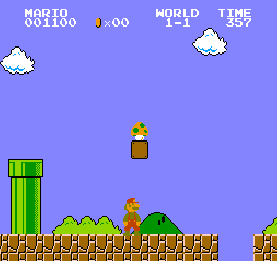
Plumbing better than Mario and Luigi
Instead of dealing with large green pipes you have to jump into,
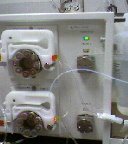
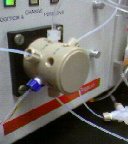
I have to deal with peristaltic pump tubing.
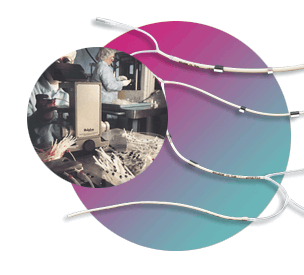
These little tubes are used to carry liquids into the mass spec. Other people use them too, such as chemists who use HPLC, IC, and SFA.
About twice a month, I have to run an analysis called FIAS or TTRA. Too make a long expanation short, the samples are mixed with buffer (pH 5.5) and internal standard (Y, In, Tb) all "online", then pushed through a column with an affinity resin that grabs the transition metals and lets the group I metals pass through. Then, the column is washed with acid, which rinses the transition metals into the mass spec which sorts them and counts them.

The way the literature describes to do this was unecessarily complicated. It explained using a sample loop and employing a water line to wash the column. It involved two valves, two pumps, four peristaltic pump lines, a double six-way valve, and finally the column.That's the way I did it and it worked for a while, but eventually it stopped working properly and I couldn't fix it. So instead of spending multiple days troubleshooting, I decided to just completely start over and re-think the whole thing.
I re-plumbed it much more simple and straight forward. Both valves, half of the double six-way valve, and the water line ended up being unnecessary. Now, loads of para-film were no longer needed to prevent leaks in the peristaltic pump tube connections. Also, less sample is used.
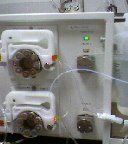
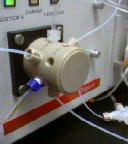

I have to deal with peristaltic pump tubing.

These little tubes are used to carry liquids into the mass spec. Other people use them too, such as chemists who use HPLC, IC, and SFA.
About twice a month, I have to run an analysis called FIAS or TTRA. Too make a long expanation short, the samples are mixed with buffer (pH 5.5) and internal standard (Y, In, Tb) all "online", then pushed through a column with an affinity resin that grabs the transition metals and lets the group I metals pass through. Then, the column is washed with acid, which rinses the transition metals into the mass spec which sorts them and counts them.
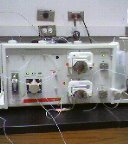
The way the literature describes to do this was unecessarily complicated. It explained using a sample loop and employing a water line to wash the column. It involved two valves, two pumps, four peristaltic pump lines, a double six-way valve, and finally the column.That's the way I did it and it worked for a while, but eventually it stopped working properly and I couldn't fix it. So instead of spending multiple days troubleshooting, I decided to just completely start over and re-think the whole thing.
I re-plumbed it much more simple and straight forward. Both valves, half of the double six-way valve, and the water line ended up being unnecessary. Now, loads of para-film were no longer needed to prevent leaks in the peristaltic pump tube connections. Also, less sample is used.
Wednesday, September 13, 2006
How to make a 1000 fold dilution
Making dilutions is an everyday thing when analyzing environmental samples. It's either diluting salt water samples by 10 because they have such a high ion content they suppress the plasma and cause internal standards to drop too low or diluting sediment samples because it takes more acid to digest them than is in the calibration standards.
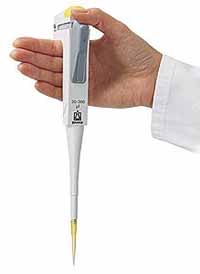
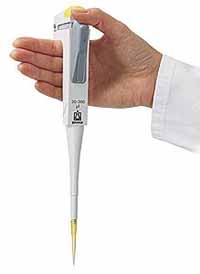
Before entering into environmental analytical chemistry I would say to make a 1000 fold dilution, add 1000mL to 1 mL of what you're trying to dilute. But that's wrong, you add 999mL to 1mL of what you're trying to dilute. Reason is, it's already diluted once. If you start with pure copper for example, and stuck it in a beaker, then you would have to add 1000mL to dilute it 1000 fold. But if the copper is already dissolved in 1mL, then you would have to add 999mL to dilute to 1000 fold. I'm pretty sure you typically don't see pure metals, sitting around an environmental chemistry laboratory waiting to be dissolved into standards. It's much easier and cost effective to buy the metals already dissolved in water in nice, guaranteed concentrations, like 10,000ppm.
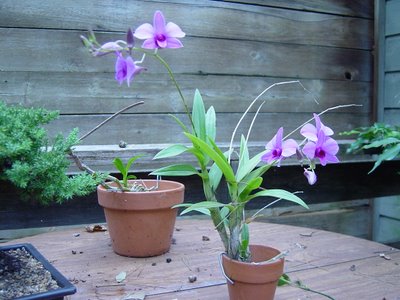
I can grow orchids --->

Before entering into environmental analytical chemistry I would say to make a 1000 fold dilution, add 1000mL to 1 mL of what you're trying to dilute. But that's wrong, you add 999mL to 1mL of what you're trying to dilute. Reason is, it's already diluted once. If you start with pure copper for example, and stuck it in a beaker, then you would have to add 1000mL to dilute it 1000 fold. But if the copper is already dissolved in 1mL, then you would have to add 999mL to dilute to 1000 fold. I'm pretty sure you typically don't see pure metals, sitting around an environmental chemistry laboratory waiting to be dissolved into standards. It's much easier and cost effective to buy the metals already dissolved in water in nice, guaranteed concentrations, like 10,000ppm.
I can grow orchids --->


Wednesday, August 30, 2006
How to get motivated for work
Someone asked me the other day how I got motivated for work. It didn't come out of the blue, we've been having some serious mass spec problems we just can't figure out. Turns out now, the technician can't really figure it out either. I replied I have to get paid, just kind of as a joke. I didn't really have time to think about it.
Maybe it's actually competition. Not just from people around me in the present, but people in the past. Stories of old chemists discovering things, having moments of clearity, and thinking "eureka!" actually motivates me. Maybe if I don't give in to working and feeling like a slave I'll get better at what I'm doing. The only way to solve a problem is to see the answer. It's hard to keep an open vision and look at things in a new way when you give into the stress of work problems.
So, to get motivated for work, seek inspiration from the past.
Maybe it's actually competition. Not just from people around me in the present, but people in the past. Stories of old chemists discovering things, having moments of clearity, and thinking "eureka!" actually motivates me. Maybe if I don't give in to working and feeling like a slave I'll get better at what I'm doing. The only way to solve a problem is to see the answer. It's hard to keep an open vision and look at things in a new way when you give into the stress of work problems.
So, to get motivated for work, seek inspiration from the past.
Tuesday, August 15, 2006
Unheard of ICPMS drift: Rabbit Pump Drift
Fellow mass spectrometerists, check this out. I'm running some calibration standards and all the sudden, from the 100ppb to the 200ppb, internal standard recovery changes from 100% to 80%. Naturally thought it was sample introduction; checked for clogs, changed cones, changed to new nebuliser, still same drift, sometimes after 5 cups. Then it eventually, 5 cups or so, it kind of creeps back up around 100%.
Today, I was looking at the real time display, in deep thought while I watched the 115In and 209Bi signal intertwine bouncing across the 20 in. flat screen when I figured it out. I accessed the accessory window and switched the peristaltic pump into rabbit mode[1]. Sure enough, the signal drops, probably around 80%, but just going off counts per second at the time. Let it equilibrate and switch it back to regular pump speed, 24%. Oh, man, took like 3 or 4 minutes for the counts to get back up to where they were before rabbit pump.
Edited ACL script, no rabbit pump, calibrated fine, loaded samples, got to name a new type of drift: Rabbit Pump Drift.
I also named Seesaw Drift, this is when the low mass internal standards drift up while the high mass internal standards drift down, or the other way around.
[1] This is what the software that runs the ICPMS calls max speed pumping. Good for washing the probe during rinse.
Today, I was looking at the real time display, in deep thought while I watched the 115In and 209Bi signal intertwine bouncing across the 20 in. flat screen when I figured it out. I accessed the accessory window and switched the peristaltic pump into rabbit mode[1]. Sure enough, the signal drops, probably around 80%, but just going off counts per second at the time. Let it equilibrate and switch it back to regular pump speed, 24%. Oh, man, took like 3 or 4 minutes for the counts to get back up to where they were before rabbit pump.
Edited ACL script, no rabbit pump, calibrated fine, loaded samples, got to name a new type of drift: Rabbit Pump Drift.
I also named Seesaw Drift, this is when the low mass internal standards drift up while the high mass internal standards drift down, or the other way around.
[1] This is what the software that runs the ICPMS calls max speed pumping. Good for washing the probe during rinse.
Monday, August 14, 2006
Typical drift problems
Links to help solve drift problems: link 1 , Perkin Elmer, Spectroscopy magazine, PlasmaChem.
It's not the sample introduction, it can't be.
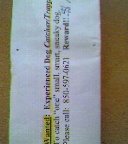 If you don't want to turn your head, translation for above, Wanted: Experienced Dog Catcher/Trapper to catch "one" small, smart, sneaky dog. Please call .... How great is that? Anybody up to it?
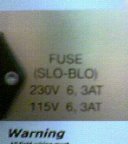
Random shot from the lab, do you think the guys who made this piece of equipment had a little laugh?
It's not the sample introduction, it can't be.
 If you don't want to turn your head, translation for above, Wanted: Experienced Dog Catcher/Trapper to catch "one" small, smart, sneaky dog. Please call .... How great is that? Anybody up to it?
Random shot from the lab, do you think the guys who made this piece of equipment had a little laugh?
Sunday, August 6, 2006
Cones before and after
A sample cone looks like this after you clean it:
 And a skimmer cone looks like this after some samples:
 I think that is permanganate built up on there. Anybody else have an idea?
 And a skimmer cone looks like this after some samples:
 I think that is permanganate built up on there. Anybody else have an idea?
Friday, July 21, 2006
Slow down
It's hard to keep up in the blog world when your trying to move. I mean moving to a different residence. You always forget how much of a pain it is. I've got everything packed up in I-CHEM boxes swiped from work. Well they're not really swiped, they were getting thrown away.
Anyways, anyone know how to clean an extraction lens or re-install instrument controlling software without getting a headache?
Anyways, anyone know how to clean an extraction lens or re-install instrument controlling software without getting a headache?
Wednesday, July 5, 2006
Silver crashes
The other day I took on the rather long task of making a multi-element solution. A multi-element solution is exactly what it sounds like, a solution (a mixture of dissolved stuff), the dissolved stuff being many different elements. This particular solution was to be composed of 27 different metal elements such as chromium, arsenic, and manganese. One way to start making this solution is to dissolve different metallic salts, like As2O3, into a diluted acid (HNO3 or nitric acid) solution. But, I don't have to do that, we buy the metals already dissolved in acidic solutions.
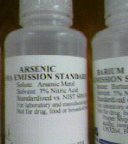
So all I have to do is successfully pipette certain amounts like 10mL, 1mL, or 0.1mL. Then dilute the solution to 1 or 2L in a class A volumetric flask. It's not that hard if you got good lab technique, but you do have 27 chances to accidently add the wrong amount. Anyways, silver is always a little tricky to get into a solution. It always wants to precipitate out. I think it forms AgCl. The Cl anions come from the HCl I add to the solution along with the HNO3 to stabilize the metals. One way to prevent precipitation is to add the HCl last after the silver has already been added and is diluted throughout everything else. But in general, silver can't be put in a multi-element solution above 500ppb. Well for some reason I forgot everything I knew for 30 seconds and messed up the entire solution on the 27th metal, silver. As soon as I pipetted 0.5mL of a 1000ppm silver solution into about 1L of other dissolved metals + acid + water it crashed out into a white haze in the flask and eventually combined into what looks like normal table salt at the bottom of the volumetric flask, but I wouldn't put that salt on my fries.

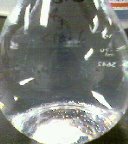

So all I have to do is successfully pipette certain amounts like 10mL, 1mL, or 0.1mL. Then dilute the solution to 1 or 2L in a class A volumetric flask. It's not that hard if you got good lab technique, but you do have 27 chances to accidently add the wrong amount. Anyways, silver is always a little tricky to get into a solution. It always wants to precipitate out. I think it forms AgCl. The Cl anions come from the HCl I add to the solution along with the HNO3 to stabilize the metals. One way to prevent precipitation is to add the HCl last after the silver has already been added and is diluted throughout everything else. But in general, silver can't be put in a multi-element solution above 500ppb. Well for some reason I forgot everything I knew for 30 seconds and messed up the entire solution on the 27th metal, silver. As soon as I pipetted 0.5mL of a 1000ppm silver solution into about 1L of other dissolved metals + acid + water it crashed out into a white haze in the flask and eventually combined into what looks like normal table salt at the bottom of the volumetric flask, but I wouldn't put that salt on my fries.


Sunday, June 25, 2006
Plasma in the window
You know a lot of people play Sudoku and work crossword puzzles to exercise their mind. Any chemists out there ever try to draw out syntheses for natural products or any other molecules to gain extra brain power? Here's a shot of the plasma from the lab.

The color of the plamsa is actually white, but the window is tinted green with something that prevents the UV light from harming our eyes. The ultraviolet light is emitted from the metals in the water samples after they gain energy from the plasma. There is actually no reason for the window at all, it just looks cool.
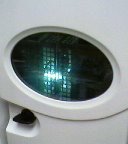
The color of the plamsa is actually white, but the window is tinted green with something that prevents the UV light from harming our eyes. The ultraviolet light is emitted from the metals in the water samples after they gain energy from the plasma. There is actually no reason for the window at all, it just looks cool.
Monday, June 19, 2006
Quality Control Explained
Quality control in ensuring your product, or scientific result falls in between a set of guidelines determined by the necessary amount of accuracy and precision required. It allows a customer to know how reliable a scientific result is.
For instance, say you want to analyze some water samples from off the coast of Louisiana to check if there is any lead contamination because the battery factory was flooded and damaged from a hurricane. To start with, you might want to take samples in various locations and record some type of data like distance from shore and maybe depth of sample taken along with the pH of the water. To tell that the guy or girl sampling the water hasn't contaminated it themselves, they'll need to take some DI water up with their water sampling equipment and bottle that up to go with all the sea water samples.
Then, it'll get back to the lab and it will have to be prepared to be analyzed, the preparer will include another blank with the batch of sea water samples to ensure that he or his lab did not contaminate the samples. These blank samples are representative of the whole batch of samples, if they have any lead in them, then all the other sea water samples would be expected to have the same amount. That's why you gotta keep it all clean, with a mass spec you're usually looking for pretty low amounts.
To be continued... as a series or possibly just a trilogy.
For instance, say you want to analyze some water samples from off the coast of Louisiana to check if there is any lead contamination because the battery factory was flooded and damaged from a hurricane. To start with, you might want to take samples in various locations and record some type of data like distance from shore and maybe depth of sample taken along with the pH of the water. To tell that the guy or girl sampling the water hasn't contaminated it themselves, they'll need to take some DI water up with their water sampling equipment and bottle that up to go with all the sea water samples.
Then, it'll get back to the lab and it will have to be prepared to be analyzed, the preparer will include another blank with the batch of sea water samples to ensure that he or his lab did not contaminate the samples. These blank samples are representative of the whole batch of samples, if they have any lead in them, then all the other sea water samples would be expected to have the same amount. That's why you gotta keep it all clean, with a mass spec you're usually looking for pretty low amounts.
To be continued... as a series or possibly just a trilogy.
Subscribe to:
Posts (Atom)
